
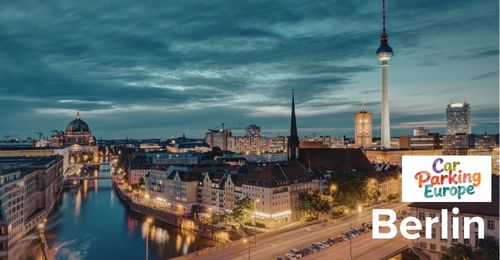
Park and Ride in Berlin
Berlin is one of the easier European capitals to approach by car, but parking in the centre is expensive, time-consuming and often impractical for a day out. The smarter move is to leave the car at one of the park and ride sites on the city's edge and continue by S-Bahn, U-Bahn or regional rail. Most sites charge nothing at all, and the public transport network gets you into the heart of the city quickly.
Parking cost
Free at most locations No charge at the majority of official P+R sites in BerlinTo Alexanderplatz
About 15 to 35 minutes By S-Bahn or U-Bahn from most park and ride locationsLines served
S-Bahn, U-Bahn and regional rail Sites are linked directly to train platformsWhy use a park and ride in Berlin?
Berlin does not have a charging zone like Milan's Area C or a camera-enforced restricted area like Rome's ZTL. Most modern cars can drive anywhere in the city without restriction. What makes park and ride attractive here is something simpler: central parking in Berlin is scarce, increasingly paid and can cost ten euros or more per day. At a park and ride site, you pay nothing and the train does the rest.
The P+R network in Berlin is managed by the city rather than a single commercial operator. Sites are spread across the outer districts, each located directly at a train or metro station. According to the most recent Berlin Senate survey, there are more than 50 designated P+R sites in the city, connected to the S-Bahn, U-Bahn and regional rail lines operated by BVG and S-Bahn Berlin.
Free parking plus a single BVG ticket is still cheaper than central parking alone
A day in a central Berlin car park can easily cost €10 to €20 or more. At almost any park and ride site, the parking is free. Add a 24-hour BVG ticket at €11.20 and you still come out well ahead, with the bonus of not having to search for a space.
Main park and ride locations in Berlin
The best location depends on which direction you are arriving from. Most sites sit just beyond or near the S-Bahn Ring, which roughly marks the boundary between the inner city and the outer districts.
| P+R location | Transit | Spaces | To Alexanderplatz | Best arriving from |
|---|---|---|---|---|
| P+R Alt-Tegel | U6, S-Bahn | ~350 | ~25 min | Northwest, A111, A10 north |
| P+R Blankenburg | S1 / S2 / S8 / S9 | ~250 | ~25 min | North, multiple S-Bahn interchange |
| P+R Ahrensfelde | S7 | ~200 | ~20 min | East, A10 from Frankfurt (Oder) |
| P+R Altglienicke | S9 / S45 | ~250 | ~30 min | Southeast, A10, near BER airport |
| P+R Alt-Mariendorf | U6 | ~150 | ~20 min | South, A100 ring, A10 south |
| P+R Biesdorf | S5 | ~120 | ~20 min | East, A10, along the S5 corridor |
| P+R Hermsdorf | S1 | ~120 | ~30 min | North, A111, along the S1 corridor |
| P+R Friedrichshagen | S3 | ~150 | ~35 min | Far east, near Müggelsee |
| P+R Bundesplatz | U9 / S-Ring | ~75 | ~15 min | West, A100, Wilmersdorf |
| P+R Buckower Chaussee | S2 | ~120 | ~30 min | South, Lichtenrade, A10 south |
| P+R Buch | S2 | ~150 | ~35 min | Far north, Pankow district |
| P+R Grünau | S8 / S9 / S45 / S46 | ~100 | ~30 min | Southeast, Köpenick direction |
Space counts are approximate, based on the 2023/24 Berlin Senate P+R survey. Availability varies and sites fill up during peak commuter hours.
Map of park and ride locations in Berlin
Park and ride rates in Berlin
The standout feature of Berlin's P+R network is that almost all sites are free of charge. Unlike most major European cities, there is no parking fee at the designated P+R spaces next to train stations. A small number of sites, particularly those that have been absorbed into paid parking zones over time, may charge a low hourly or daily rate. Signs at the entrance will make this clear.
| Situation | Rate | Notes |
|---|---|---|
| Standard P+R spaces | Free | The large majority of Berlin's designated P+R sites |
| Sites within a paid parking zone | Varies, usually low | A small number of former P+R sites have been included in paid zones; check signage on arrival |
| Overnight parking | Usually permitted | Most sites are open around the clock, though some have restricted hours |
Sites fill up quickly on weekday mornings
Because parking is free, the most popular P+R sites in Berlin attract a lot of daily commuters. If you are arriving mid-morning or later, spaces at busier locations such as Alt-Tegel or Ahrensfelde may already be taken. Arriving earlier, or choosing a slightly less central site, usually solves this.
The three best park and ride locations for visitors
These three sites offer the best combination of accessibility, transit connections and space availability for visitors arriving from outside Berlin.
Alt-Tegel, U6
Alt-Tegel is the most practical choice for visitors arriving from the northwest. It sits near the A111 motorway and has good S-Bahn and U6 connections. The U6 line runs straight through the city, passing through Hauptbahnhof, Friedrichstraße and Stadtmitte, making it easy to reach most central sights without changing trains.
Ahrensfelde, S7
Ahrensfelde is the eastern terminus of the S7 line, which runs directly into Alexanderplatz, Ostbahnhof and on towards Hauptbahnhof. The journey into the centre takes around 20 minutes and the S7 runs frequently. It is the natural option for drivers coming from the A10 on the eastern side of the city.
Alt-Mariendorf, U6
Alt-Mariendorf is a reliable option for anyone arriving from the south via the A100 or A10. It sits at the southern end of the U6 line, which runs north through Tempelhof, Kreuzberg and into the city centre. The journey to central Berlin takes around 20 minutes and the line runs without changes.
The Umweltzone: what you need to know
Berlin has an environmental zone, called the Umweltzone, which covers the area inside the S-Bahn Ring. To drive within this zone, your vehicle must display a coloured environmental sticker, known as the Umweltplakette. Most modern cars, including the majority of petrol and diesel vehicles built after around 2005, qualify for a green sticker and can drive in without any restriction. Older or more heavily polluting vehicles may need a yellow or red sticker, or may not be permitted to enter the zone at all.
This is one additional reason to consider park and ride if you are travelling in an older car. Parking just outside the S-Bahn Ring and continuing by train keeps things simple and avoids any potential issues with the zone.
Most modern rental cars and recent private vehicles are fine
If you are driving a car built in the last 10 to 15 years, the Umweltzone is unlikely to affect you. Rental cars in Germany are generally assigned a green sticker as standard. If you are unsure about your own vehicle, it is worth checking before your trip. The sticker itself costs around €6 to €30 and can be purchased at vehicle inspection centres, many car dealers and some online services.
BVG tickets to use with your park and ride
After parking, you need a BVG ticket to continue by train or metro. Berlin is split into fare zones: AB covers the whole city within the city limits, and ABC additionally includes the surrounding Brandenburg area and BER Airport. For most visitors, an AB ticket covers everything they need. Tickets can be bought at machines on every platform, via the BVG app, or on trams directly.
| Ticket type | Price (AB) | Validity |
|---|---|---|
| Single ticket | €4.00 | 2 hours, unlimited changes, 1 direction only |
| Short trip ticket | €2.80 | 3 stops on S/U-Bahn, or 6 on tram/bus |
| 4-trip ticket | €12.40 | 4 x single ticket, slight saving per trip |
| 24-hour ticket | €11.20 | 24 hours, unlimited journeys |
| 24-hour group ticket | €35.30 | 24 hours, up to 5 people |
Already have a Deutschlandticket? You can use it on all BVG services
The Deutschlandticket, currently priced at €58 per month, is valid on all S-Bahn, U-Bahn, tram and bus services across Germany, including the entire BVG network in Berlin. If you are travelling from another German city and already hold the Deutschlandticket, you pay nothing extra for public transport once you have parked.
Our advice: park and ride is a simple and free way into Berlin
Berlin's park and ride network is one of the most visitor-friendly in Europe, largely because it costs nothing to use. If you are coming to the city by car, the combination of free parking at a station on the edge of the city and a BVG ticket into the centre is almost always more convenient and cheaper than driving all the way in and paying for central parking.
For most visitors, Alt-Tegel, Ahrensfelde and Alt-Mariendorf are the names to know, depending on which direction you are arriving from. Arrive early to secure a space, buy your BVG ticket and let the S-Bahn or U-Bahn take care of the rest.
Based on the 2023/24 P+R survey conducted by the Berlin Senate for Mobility, Transport, Climate Protection and Environment together with VBB and BahnStadt GmbH, current BVG tariff information and Umweltzone regulations published by the City of Berlin. Space counts are approximate. Availability, site status and BVG ticket prices are subject to change, so always check current information before you travel.